
Dental Implants Near Westmead
A gap left by an extracted molar, a front tooth that cracked beyond repair or a partial denture that never feels secure can all change the way you eat and smile. For people living or working around Westmead, finding time to deal with a missing tooth can also be hard between hospital shifts, study and family commitments. In suitable cases, a dental implant can provide a fixed replacement that looks and functions much like a natural tooth.
Parramatta Green Dental offers dental implants near Westmead from our clinic inside Westfield Parramatta, one stop from Westmead on the train. Before any recommendation is made, our dentist examines your mouth, reviews your health history and uses imaging to check whether an implant is a sensible option for you.
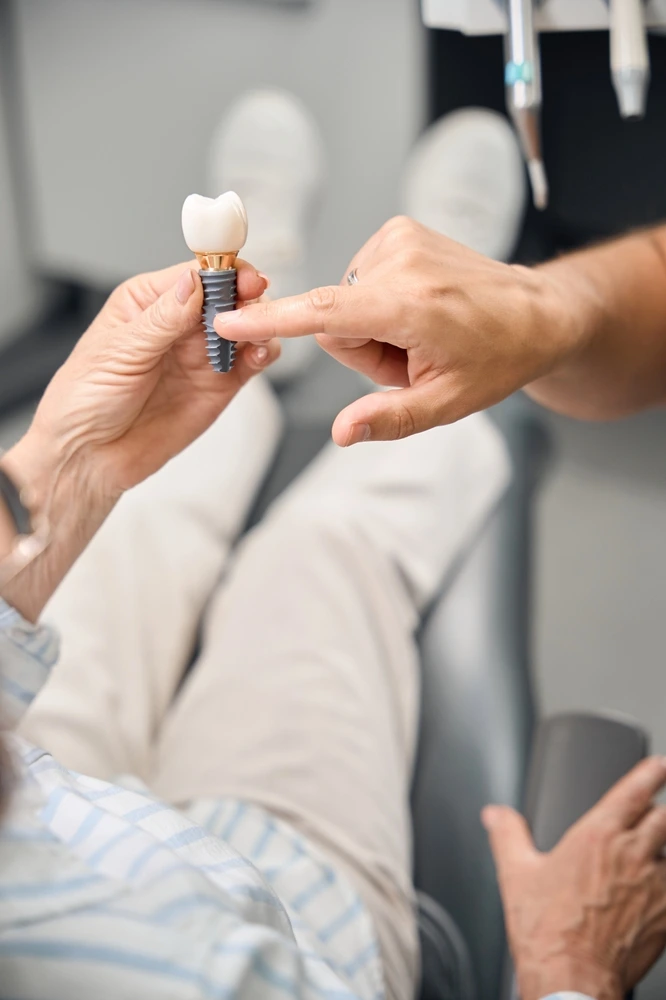
Implant, Bridge Or Denture: Weighing Up Your Options
There is more than one way to replace a missing tooth, and the right choice depends on your mouth, health, budget and priorities. Our dentist will talk you through each option so you can compare them properly.
A dental implant is a small biocompatible post placed in the jawbone, where it acts as an artificial root for a crown, bridge or denture. Because it is anchored in bone, a single implant crown does not depend on the teeth either side of the gap.
A conventional bridge attaches a replacement tooth to neighbouring teeth, which are usually prepared to hold crowns. It can often be completed faster than an implant and without surgery, but it relies on those supporting teeth staying healthy.
Removable dentures can replace one tooth or many and usually cost less at the outset. Some people adapt to them well, while others find them loose or bulky. Where several teeth are missing, implants can sometimes be used to stabilise a denture or support a fixed bridge instead.
In some situations, leaving a gap and monitoring it is also reasonable. We will explain what may happen to the bite and nearby teeth if a space is left unfilled.
What We Check At Your Implant Assessment
An implant needs healthy gums, enough bone and a bite that will not overload the new tooth. Your first appointment is used to gather that information.
Our dentist will examine the gap, the surrounding teeth and your gums, and look at how your upper and lower teeth meet. Depending on the site, we may take digital X-rays, an OPG or a cone beam 3D scan to measure the height and width of the bone and locate nearby structures such as nerves and the sinuses.
If the bone has thinned since the tooth was lost, bone grafting or another preparatory step may be discussed. Not every patient needs grafting, and we only recommend it where the imaging and examination show it is required.
Any decay, gum disease or infection elsewhere in the mouth is usually treated before implant placement. Once the assessment is complete, you receive a written plan outlining the proposed stages, timing, risks and fees.
Health Conditions And Medicines To Tell Us About
Many Westmead residents are already under the care of specialists at the hospitals in the local health precinct. Your general health can affect how well the bone heals around an implant, so a full and accurate medical history is essential.
Please let us know if you have or are being treated for any of the following:
- Diabetes, particularly if blood sugar levels are hard to control
- Osteoporosis or other conditions treated with bisphosphonates or similar bone medications
- Blood-thinning medication or a bleeding disorder
- Heart conditions or recent cardiac procedures
- Current or past cancer treatment, including radiotherapy to the head or neck
- Immune conditions or medicines that suppress the immune system
- Smoking or vaping
Some of these factors may simply mean extra precautions or a longer healing period. Others may change whether implants are advisable. Where appropriate, we may ask for information from your GP or specialist before treatment begins.
Bring a current list of your medicines to your consultation, including supplements and anything prescribed by a hospital team.
From Planning To Your Final Crown
Implant treatment happens over several appointments, and it helps to know the general sequence before you begin.
If a damaged tooth still needs to come out, it is removed first. Where clinically suitable, our dentist may place the implant at the same visit, an approach known as immediate implant placement. In other cases, the site is left to heal for a period beforehand.
The implant is placed under local anaesthetic. Over the following months, the bone gradually bonds to the implant surface. Depending on the site and appearance, a temporary tooth may be provided during this time.
When the implant is stable, impressions or scans are taken so your permanent crown, bridge or denture is made to match your bite and the shade of your teeth. It is then fitted and checked, with any adjustments made at a review visit.
The overall timeframe varies from person to person. Extraction, grafting, healing speed and the type of restoration all affect how long treatment takes.
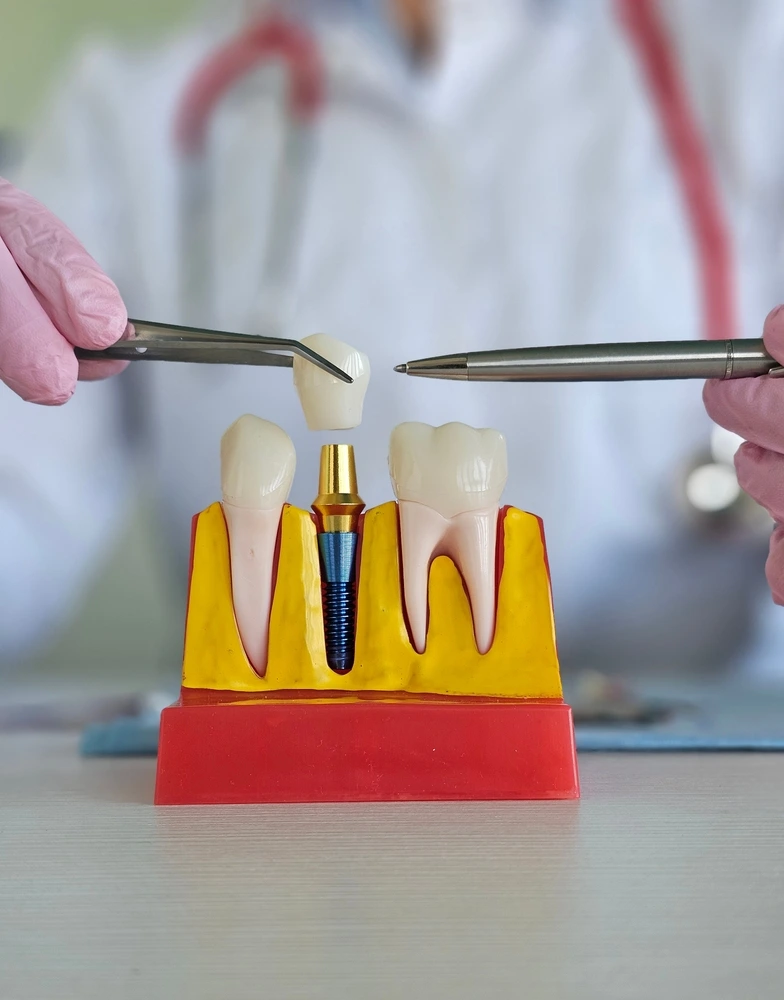
Thinking About Implant Treatment Overseas?
Some patients ask us about having implants placed while visiting family abroad, often because the upfront price appears lower. It is a personal decision, and we are happy to discuss the factors worth considering.
Implant treatment usually needs several visits over a number of months, along with checks after the crown is fitted. Fitting this around a single trip can mean shorter healing times than would otherwise be planned. If a problem appears after you return, it can be harder to obtain the original records or matching implant components.
If you already have an implant placed elsewhere, our dentist can examine it, take X-rays and advise on maintenance. Bringing any treatment records or details of the implant system helps.
Caring For Your Implant Over The Years
An implant crown cannot decay, but the gum and bone around it can become inflamed if plaque builds up. This condition, known as peri-implantitis, can lead to bone loss around the implant if left untreated.
Brush twice a day and clean between your teeth and around the implant each day, using the floss, interdental brushes or water flosser our team recommends. Regular check-ups and professional cleans allow us to monitor the gums, bone levels and bite.
If you grind or clench your teeth, we may suggest a night guard to help protect the crown and supporting implant. Crowns, bridges and dentures can wear or chip over time and may eventually need repair or replacement. No implant can be promised to last a lifetime.

Why Westmead Patients Choose Parramatta Green Dental
Parramatta Green Dental has been caring for patients across Western Sydney since 2015. Our team includes dentists, an oral health therapist, an oral hygienist and a visiting oral surgeon. If your case would benefit from a specialist, we can arrange a referral to an appropriate practitioner.
Implant planning is supported by cone beam 3D imaging, an OPG, digital X-rays, an intraoral camera, dental loupes and a dental microscope in one surgery.
Dr Nazila Nosratieh holds a Doctor of Dental Surgery and a PhD in Oral Biology. She has practised in Australia since 2008 and has been a practice owner since 2011. Dr Rajlaxmi Singh holds a Bachelor of Dental Surgery and is a member of the Australian Dental Association.
Our team members speak Hindi, Telugu, Gujarati, Nepali, Persian, Arabic and Korean, which can make it easier for patients and their families to ask questions and understand the treatment plan. Because we also provide general dentistry, crowns, bridges, dentures and clear aligners, your implant is planned alongside the health of the rest of your mouth.
Implant Fees, Health Funds And Payment Options
The cost of implant treatment depends on how many teeth are being replaced, the imaging required, the type of restoration and any extractions or grafting required beforehand. We provide an itemised estimate after your assessment so you can see the cost of each stage.
If you hold private health insurance with extras cover, ask your fund what it will pay towards the item numbers on your estimate. Benefits, annual limits and waiting periods differ between policies, and some cover only part of implant treatment.
Our clinic accepts Zip Money, Afterpay and Humm. Eligibility criteria, fees and terms apply, so please read the provider’s conditions before signing up.
Getting To Our Clinic From Westmead
Parramatta Green Dental is at Shop 1141B, 159–175 Church Street, inside Westfield Parramatta.
By train, Westmead station is a single stop from Parramatta on the T1 Western Line, and Westfield Parramatta connects to the Parramatta Transport Interchange. Patients near the hospitals can also take the L4 Westmead and Carlingford Line light rail to Parramatta Square, then walk a few minutes to the centre.
By car, the trip from most of Westmead is around 3 to 4 kilometres and usually takes about 10 minutes, depending on traffic along the Great Western Highway or Hawkesbury Road. Westfield Parramatta has onsite parking. Check the Transport for NSW Trip Planner for current timetables and any trackwork.
We are open six days a week, with extended hours on Thursday, which can help patients who work rotating shifts or standard business hours fit implant appointments into their schedule.
Proudly Serving Westmead And Neighbouring Suburbs
Westmead sits just west of the Parramatta CBD, with Parramatta Park and the Parramatta River on its eastern side. The suburb is best known for the Westmead Health Precinct, which brings together Westmead Hospital, The Children’s Hospital at Westmead, Westmead Private Hospital, medical research institutes and the Western Sydney University Westmead campus.
Beyond the precinct, Westmead is a busy residential suburb of apartments, townhouses and family homes. Hawkesbury Road and the streets around Westmead station are lined with cafes and grocers that reflect one of Sydney’s largest Indian-born communities. The suburb lies partly in the City of Parramatta and partly in Cumberland City Council.
We also welcome patients from Merrylands, Granville, Wentworthville, and Auburn.
* Any invasive or surgical procedure may carry risks. Before moving forward, it is recommended that you seek a second opinion from an appropriately licensed medical professional.
Book Your Dental Implant Consultation
Whether you are missing one tooth or several, an assessment is the first step in finding out if implants suit you and how they compare with a bridge or denture.
Contact us or call 02 9687 2899 to arrange a dental implant consultation for Westmead patients now.
Frequently Asked Questions
How far is the clinic from Westmead?
Westfield Parramatta is about 10 minutes by car from most of Westmead. By train, it is one stop from Westmead station to Parramatta.
Can I have an implant if I take medicine for osteoporosis?
Possibly. Some bone medications can affect healing after implant surgery. Tell our dentist exactly what you take and for how long, and we may consult your doctor before recommending treatment.
Can an implant replace a tooth that was removed years ago?
Often, yes, although the jawbone can shrink after a tooth is lost. Imaging will show whether there is enough bone or whether grafting may be needed first.
Will I be without a tooth while the implant heals?
Not necessarily. Depending on where the gap is, a temporary tooth or denture may be provided while the implant bonds with the bone.
Can you check an implant that was placed overseas?
Yes. Our dentist can examine it and take X-rays. Bring any records you have, including the brand of implant if known.
Do you have Hindi- or Telugu-speaking team members?
Yes. Our team includes members who speak Hindi, Telugu, Gujarati, Nepali, Persian, Arabic and Korean. Let us know your preferred language when booking.
Are implants available through the public dental service?
Public dental services offer implants only in limited circumstances, with separate eligibility and clinical criteria. Contact the service directly to check whether you qualify.
How long will my implant last?
It varies. Oral hygiene, regular check-ups, smoking, general health and grinding habits all influence how long an implant and its crown last.
Any invasive or surgical procedure may carry risks. Before proceeding, consider seeking a second opinion from an appropriately qualified health practitioner.