

When it comes to preserving your smile and protecting your teeth from infection, a root canal is often the last line of defence. Whether it’s a front tooth or a back molar, root canal therapy can save your tooth from further damage, infection, or even extraction. But not all root canal procedures are the same. The differences between front teeth and back molars often dictate how the procedure is carried out, its complexity, and even the recovery time.
We will explain the key differences between root canal treatments for front teeth (such as incisors and canines) and back teeth (including molars and premolars), so you know what to expect. Whether you’re considering a root canal for a decayed front tooth or experiencing discomfort in a molar, this guide will provide valuable insights and answer common questions, ensuring you feel informed and confident in your treatment decision.
The Anatomy of Teeth: How Front and Back Teeth Differ
Root Canal Structure in Front Teeth
Front teeth are typically simpler in terms of the anatomy of a root canal procedure. These teeth generally have one root and one canal, making the treatment more straightforward. The pulp in these teeth, the innermost part containing nerves and blood vessels, is usually less complex than the pulp in back teeth.
Because of their single root and canal, root canal therapy on front teeth is usually quicker and easier. The tooth’s visibility and accessibility allow the dentist to work efficiently, and the procedure often requires fewer appointments.
Root Canal Structure in Back Teeth
On the other hand, back teeth, specifically molars and premolars, are more complex. These teeth have multiple roots, often two to three, and multiple canals within each root. The pulp chamber in molars is larger, and the canals are more intricate.
Treating these teeth requires greater precision and time. The multiple canals in each root mean that more extensive cleaning and sealing are necessary, and the risk of infection spreading is higher. As such, molars generally take longer to treat, and the procedure may require magnification and digital imaging for proper access.
Root Canal Procedure: Complexity for Front vs Back Teeth
Root Canal on Front Teeth
When performing a root canal on a front tooth, the procedure is usually more straightforward. Because of the simpler structure (with only one root and one canal), the dentist has better access and visibility, which speeds up the treatment. In general, the procedure for a front tooth takes about 30 minutes to an hour. The treatment usually requires local anaesthesia and may involve a tooth-colored filling or composite bonding to restore the tooth.
Since the procedure is less complex, the overall cost is often lower, and the recovery time is shorter. Front teeth are also less likely to experience significant chewing pressure, making them less prone to complications after the procedure.
Root Canal on Back Teeth (Molars and Premolars)
For back teeth, such as molars and premolars, the procedure is more involved. These teeth often have multiple roots, each with multiple canals, which makes cleaning, shaping, and sealing more time-consuming. A root canal treatment for a molar may take up to 90 minutes, depending on the complexity of the tooth’s root system.
Because of the intricate structure of molars, advanced tools and techniques, like magnification and digital X-rays, are often used. The dentist may need to perform additional steps to ensure that all canals are thoroughly cleaned and sealed. After the procedure, a dental crown is usually placed on the molar to help it withstand the chewing forces it experiences daily.
Pain, Discomfort, and Sensitivity: What to Expect
Pain Management for Front Teeth Root Canals
Root canal treatment on front teeth tends to be less painful than treatment for back teeth. The single canal and simpler root structure mean that less manipulation is needed, and the overall procedure is quicker. Typically, patients will experience only mild discomfort during and after the procedure, which can be managed with over-the-counter pain relievers.
After treatment, patients may experience some sensitivity to hot and cold for a few days, but this is usually temporary and should resolve within a week. The recovery time for front-tooth root canals is often shorter, and most patients can return to their normal activities within 24-48 hours.
Pain Management for Back Tooth Root Canals
Back teeth are a different story. Due to the multiple roots and canals, root canal procedures for molars and premolars are generally more painful. The complexity of the treatment increases the risk of post-procedure discomfort. After treatment, patients may experience tenderness in the treated area, which can last several days.
Dentists typically recommend stronger pain management options, including prescription painkillers, to manage discomfort during the recovery process. Additionally, because back teeth are subjected to greater chewing pressure, patients may need to be cautious with their diet during recovery. Temperature sensitivity may also persist longer in back teeth than in front teeth.
Treatment Duration and Complexity: How Long Does It Take?
Front Teeth Root Canal Duration
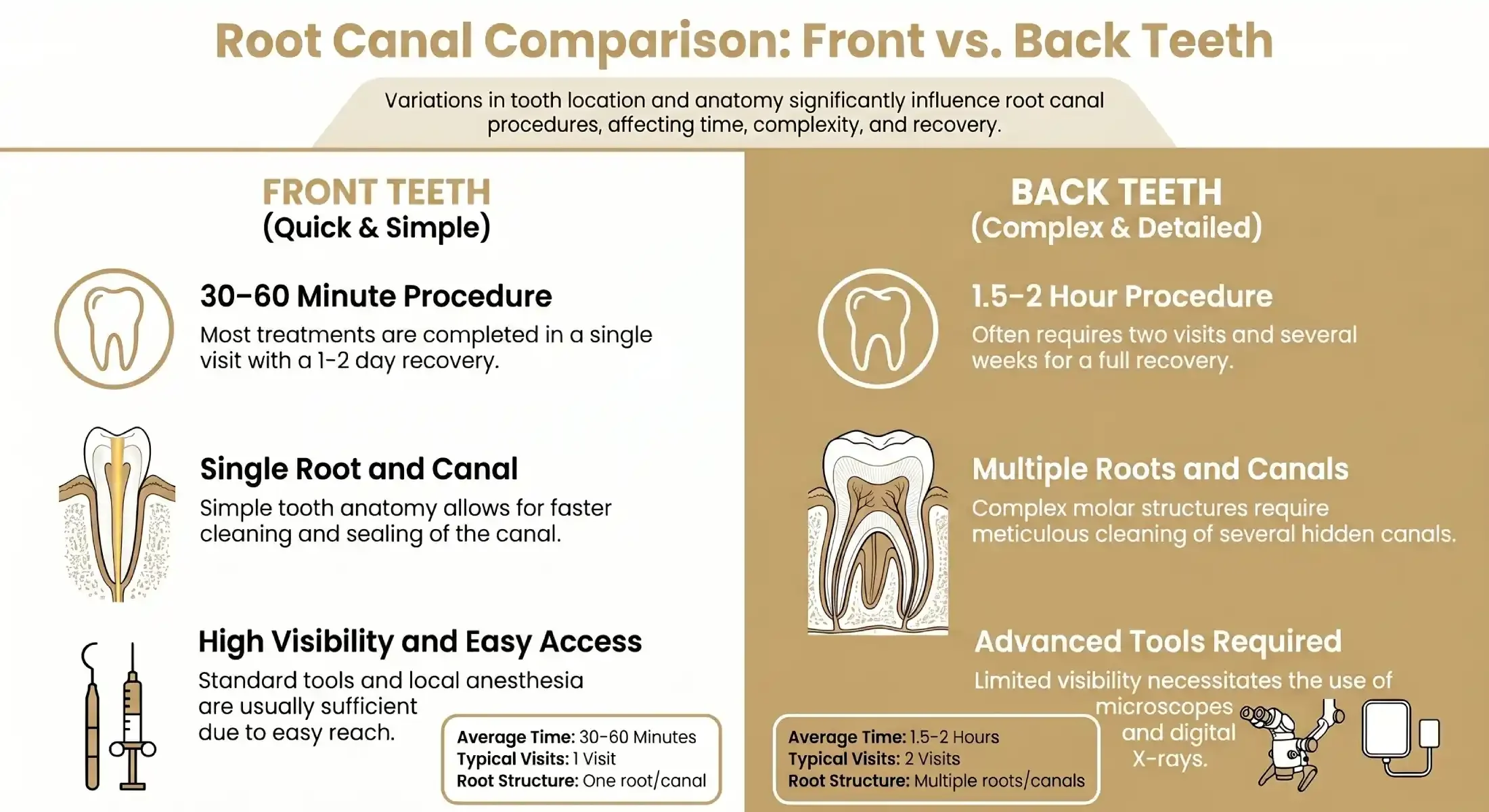
The root canal procedure for front teeth is generally quicker than for back teeth. Since there is only one root and one canal, the treatment time is reduced. On average, it takes around 30 to 60 minutes to complete the procedure for a front tooth, depending on the level of damage or infection.
The treatment is typically completed in a single visit, and patients can return to their normal routine quickly. The recovery time is also shorter, with most patients feeling back to normal within 1 to 2 days.
Back Teeth Root Canal Duration
For back teeth (molars), the procedure is more time-consuming. Multiple roots and multiple canals increase treatment time, which can extend to 1.5-2 hours. The complexity of the molar’s root structure means that the dentist needs more time to ensure all canals are properly cleaned and sealed.
Typically, the root canal treatment for a molar requires two visits: one for cleaning and shaping the canals and another for placing a final filling or crown. The overall treatment duration is longer, and recovery may take several weeks to complete. At Parramatta Green Dental, we specialise in providing compassionate, expert care for all types of root canal treatments.
Access, Visibility, and Tools Used
Front Teeth Accessibility
One reason front teeth root canals are quicker and less complex is the dentist’s easy access. Front teeth are located in the visible part of the mouth, which allows for better visibility during the procedure. The dentist can easily access the root canal with minimal discomfort to the patient.
Most front teeth root canals can be performed without advanced tools such as microscopes or digital imaging, because the tooth’s anatomy is simpler. Local anaesthesia is usually sufficient for numbing the area, and patients can expect a relatively straightforward procedure.
Back Teeth Accessibility
Back teeth pose a more significant challenge for dentists due to their location at the back of the mouth. Difficult access and limited visibility often require advanced tools, such as magnification, digital X-rays, and microscopes. These tools help the dentist see clearly inside the tooth, locate all the canals, and ensure proper treatment.
Additionally, molars are often surrounded by other teeth and may require the dentist to position the patient at an angle to get the best view. As a result, the procedure is more time-consuming and complex than root canal treatment for front teeth.
Restoration After Root Canal Treatment: What Happens Next?
Restoring Front Teeth After a Root Canal
Once a root canal is completed on a front tooth, the restoration process is generally straightforward. For front teeth, cosmetic appearance is a top priority. Most commonly, a composite filling or a tooth-coloured material is used to restore the tooth, ensuring it blends seamlessly with your natural teeth. These restorations are designed to be aesthetic and are ideal for incisors and canines, where appearance plays a major role.
In cases of significant tooth structure loss, a dental crown may be placed to ensure the tooth remains intact and protected. However, front teeth generally don’t experience the same level of chewing forces as back teeth, so a simple filling or bonding is usually sufficient to restore their strength.
Restoring Teeth After a Root Canal
For back teeth, the restoration is a bit more complex. After a molar undergoes a root canal, the dentist often needs to place a crown to restore the tooth. This is essential because molars are responsible for chewing and grinding food, so they experience much more pressure than front teeth. A dental crown for back teeth is often made from materials like porcelain, ceramic, or metal alloys to provide the strength required for daily biting and chewing.
Sometimes, additional procedures, such as post-and-core restorations, may be necessary, particularly if the tooth has sustained significant damage or decay. These types of restorations ensure the root canal-treated tooth remains functional for many years to come.
Aesthetic Considerations: Smile Impact After Treatment
Aesthetic Restoration for Front Teeth
Front teeth are highly visible, and aesthetic considerations are crucial in root canal procedures for these teeth. Discolouration can sometimes occur after a root canal treatment, especially in teeth with deeper infections or damage. In such cases, internal whitening may be performed to restore the tooth to a brighter shade.
For patients concerned about the appearance of the treated tooth, porcelain veneers or composite bonding are effective options for improving its appearance. These materials can help restore the tooth’s natural appearance, ensuring it matches the surrounding teeth in colour and texture. The goal is to make the treated tooth as aesthetically pleasing as possible.
Aesthetic Restoration for Back Teeth
Unlike front teeth, the aesthetic concerns for back teeth are less significant because they are less visible in the mouth. However, molars still require proper restoration to ensure they function well and to prevent discolouration or structural damage.
In many cases, crowns are used to restore molars, and these can be made from all-ceramic or porcelain-fused-to-metal materials, which provide both strength and a natural appearance. Though aesthetic concerns may not be as important for back teeth, maintaining function and ensuring the crown fits well in the bite are critical for overall oral health.
Cost Considerations: Is It More Expensive for Back Teeth?
Root Canal on Front Teeth: Cost Overview
A root canal treatment for front teeth tends to be less expensive compared to back teeth. This is because the procedure is simpler, requiring less time and fewer materials. For front teeth, the cost typically includes the consultation, the procedure, and the restorative filling (such as a composite bonding or a tooth-coloured filling).
Generally, the cost for a front tooth root canal ranges from $600 to $1,200 in Australia, depending on the complexity and the materials used. Many dental clinics, including Parramatta Green Dental, offer payment plans or insurance coverage to help reduce the financial burden.
Root Canal on Back Teeth: Cost Overview
The cost for a root canal on a molar is typically higher due to the greater complexity of the procedure. With multiple roots and canals, back teeth require more time, more tools, and often a crown to restore the tooth. In addition to the procedure, placing a dental crown on a back tooth adds to the cost.
A back tooth root canal (including molars) generally ranges from $1,200 to $2,500 in Australia, depending on the clinic and the materials used for the crown. The cost can vary based on factors such as the tooth’s condition, the dentist’s experience, and whether or not advanced imaging or tools are required.
Risks and Success Rates: Front vs Back Teeth
Root Canal Success for Front Teeth
The success rate for a root canal treatment on front teeth is typically very high, especially because these teeth are simpler to treat. The single canal and easier access allow the dentist to remove the infection and effectively restore the tooth. With proper care and post-treatment maintenance, most patients experience long-term success following root canal therapy for front teeth.
Root Canal Success for Back Teeth
The success rate for back teeth (molars) can be a bit more variable. While the procedure remains highly effective, increased complexity and the risk of missed canals may increase the likelihood of complications, such as treatment failure or reinfection. However, when done correctly by an experienced endodontist, the success rates for molars are still very high. The key is to ensure that the root canals are thoroughly cleaned, sealed, and restored with the appropriate materials.
Some patients may require retreatment if the initial procedure does not fully address the infection or if the tooth develops new issues, like a crack or fracture. This is more common in back teeth due to their greater exposure to chewing forces.
FAQs: Root Canal Treatment for Front vs Back Teeth
How does root canal treatment differ between front and back teeth?
Root canal treatment for front teeth is generally simpler and quicker due to their single-canal, single-root structure. Back teeth, on the other hand, have multiple canals and roots, making the procedure more complex and time-consuming. Additionally, back teeth are subjected to greater pressure during chewing, which often requires the placement of crowns for better restoration.
Is a root canal on a molar more painful than on a front tooth?
Yes, a root canal on a molar tends to be more painful. This is because molars have multiple roots and canals, which require more work and can cause more discomfort during the procedure. However, modern pain management techniques ensure that patients experience minimal discomfort.
Why does a root canal take longer for back teeth?
Root canal treatment for back teeth takes longer because they have multiple canals and roots, requiring more time to clean, shape, and seal properly. The complexity of molar anatomy makes the procedure more time-consuming than for front teeth, which usually have only one canal.
What happens if a root canal on a front tooth fails?
If a root canal on a front tooth fails, it could lead to re-infection or continued pain. In such cases, a re-treatment may be necessary, or the tooth may need to be extracted. It’s important to follow the aftercare instructions provided by your dentist to avoid complications.
How long does recovery take for a back tooth root canal?
Recovery for back teeth typically takes longer than for front teeth. Most patients experience some discomfort for 3-7 days, and the healing time can extend up to a few weeks. Follow-up appointments and careful monitoring are essential during the recovery process.
Conclusion: Making the Right Choice for Your Teeth
Choosing the right treatment for your teeth can be a crucial decision in maintaining both your oral health and appearance. While front-tooth root canals are typically simpler and quicker, they still require aesthetic care to ensure the tooth looks natural. Molars, on the other hand, require more attention due to their functional role in chewing and the complexity of the procedure. Regardless of the type of tooth, root canal treatments are effective in saving teeth from extraction and restoring their function and appearance.
At Parramatta Green Dental, we specialise in providing compassionate, expert care for all types of root canal treatments. Our experienced team uses advanced techniques and technology to ensure the best outcomes for your dental health. Whether you need a root canal for a front tooth or a molar, our team is here to guide you through the process and help you restore your smile.